Documentation

Setup & Usage Guide

Follow this step-by-step guide to configure your environment, generate AI scripts, and deploy your Chatter Bot autonomously.

Prerequisites Checklist

🧠

1. AI API Keys

A valid API key from Gemini (Google) or OpenAI (for ChatGPT models). Gemini Model is preferred.

🧠

Note: You will need to activate billing for your project tied to the generated API key to use later models such as Gemini 3/3.1 Flash. Watch this video guide which shows how to create an API key on Google AI Studio.

🔑

2. Telegram API Credentials

An api_id and api_hash registered at my.telegram.org under your Telegram account. Only one api_id and api_hash can be created per Telegram account. Use another Telegram account to create more.

⚠️

Warning: Using a cheap shared VPN can cause errors when generating API credentials on the Telegram website. It is best to use clean high-quality residential IPs/Proxies. You can create up to two API IDs and hashes per IP, after which you must switch to a different IP.

📁

3. Telegram Session Files

To use multiple accounts simultaneously, you will need Telegram session files.

  • Option 1: Purchase pre-made session files from providers like djekxa.ru or find your own sellers through searches on Google.
  • Option 2: Create your own within Chatter Bot by purchasing virtual numbers from services like juicysms.com or smspva.com.
  • Option 3: Purchase real prepaid SIM cards to receive the Telegram activation text.
📧

Registration Tip: Telegram sometimes asks for an email to register new accounts. We suggest using the Telegram Dropmail Bot or the Dropmail web interface for a temporary address.

🛡️

4. Proxy Provider (Highly Recommended)

To protect your bot accounts from bans, you need proxy IPs to rotate network traffic. We recommend providers like decodo.com as they have STATIC RESIDENTIAL IP Plans, which are cheaper than rotating ones.

🌐

Note: You must obtain high quality residential IPs, not datacenter IPs, as Telegram usually flags datacenter addresses for spam. The required proxy format for the Chatter Bot is proxyURL:port:username:password.

💡

Pro Tip: Prepare a Project URL or Whitepaper.
Have a link to your target project's website or a document with its background info ready. The Script Generator will use this to learn your specific niche perfectly!

Script Generator

Part 1: Script Generator

Generate intelligent, niche-specific conversation lines.

1

Initializing the Configuration

  1. Open the Script Generator application.
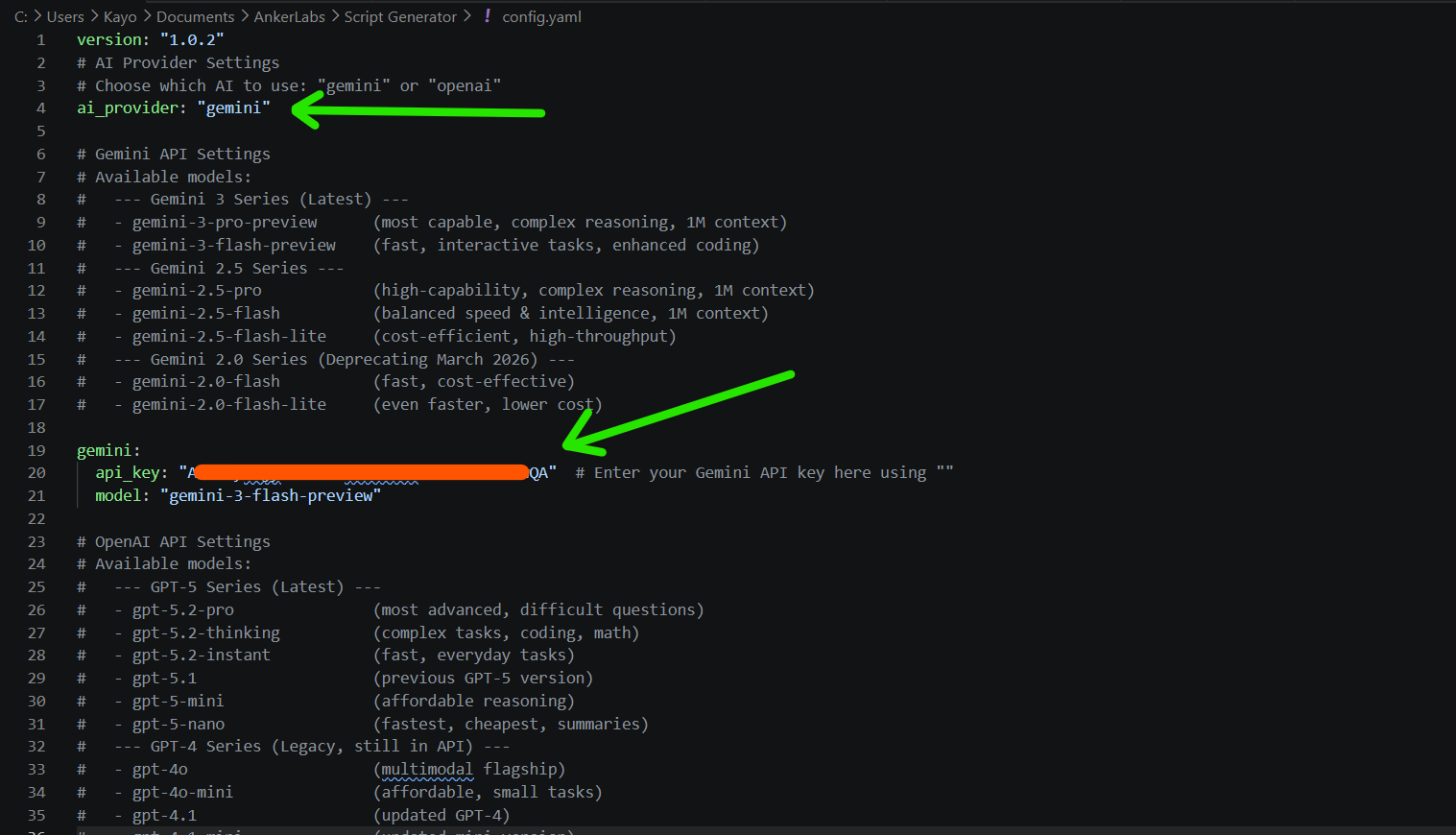
  2. Select the settings button (bottom left) then "Edit Config File" button, which opens the config.yaml file using any text editor (like Notepad).
  3. Find the ai_provider setting and set it to either "gemini" or "openai".
  4. Paste your API key into the respective api_key: "" field for your chosen AI provider. You can also change the model for your chosen AI. Currently the default Gemini Flash 3/3.1 has the best results. Feel free to experiment with newer models once you understand how the app works.
  5. Save the file.
Configuring API Provider
2

Creating a New Project

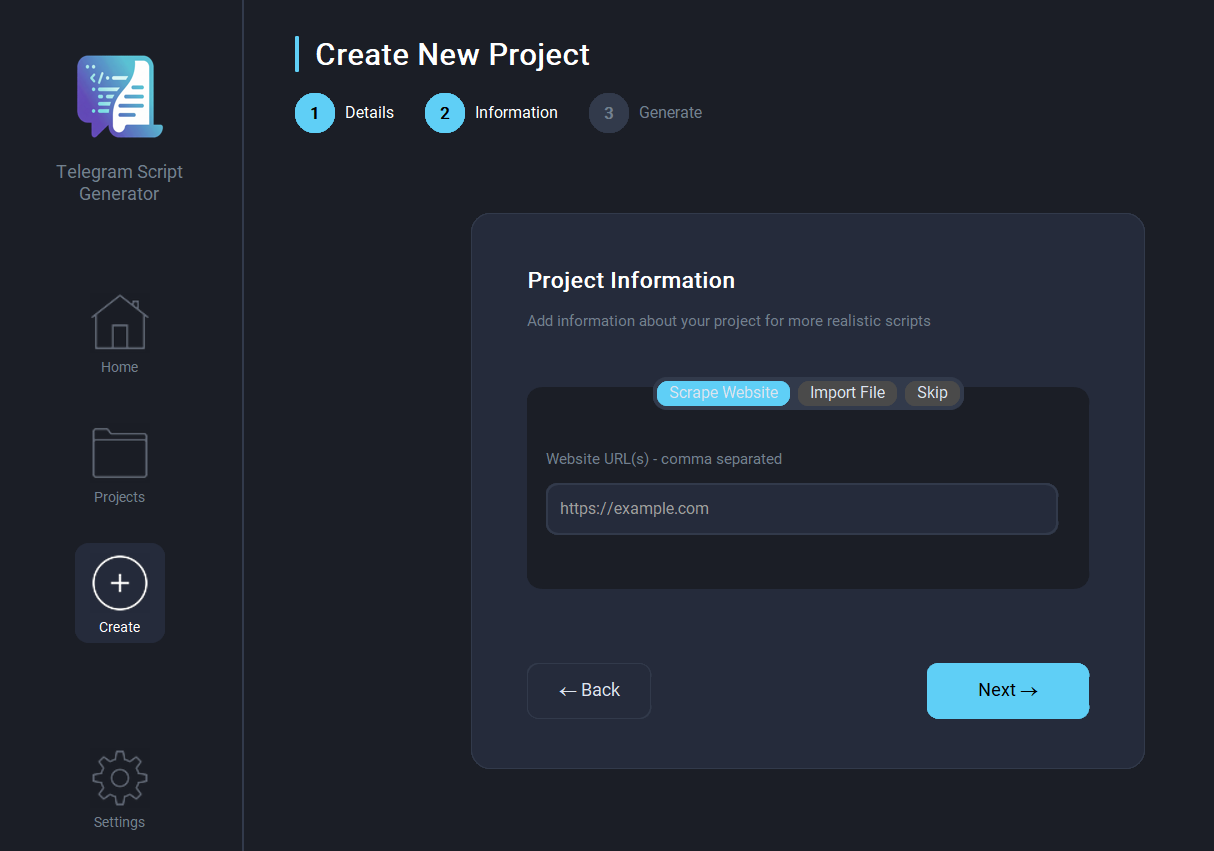
  1. From the main dashboard, click on Create New Project to open the setup wizard.
  2. Details: Enter your "Project Name" and a brief "Project Niche" (e.g., Cryptocurrency meme project).
  3. Information (Crucial Step): You have three options to feed the AI context about your project:
    • Scrape Website: Enter comma-separated URLs (e.g., your project's website or whitepaper). The AI will scrape this live.
    • Import File: Upload a .txt or .md file containing detailed project info.
    • Skip: Only skip if you intend to add info manually later.
  4. Proceed to the Generate step. The tool will take about 60+ seconds to process your data, build realistic actor profiles (Members and Moderators), and generate the foundational prompt sets (niche, general, Solo, etc).
Creating a New Project
3

Generating and Saving Scripts

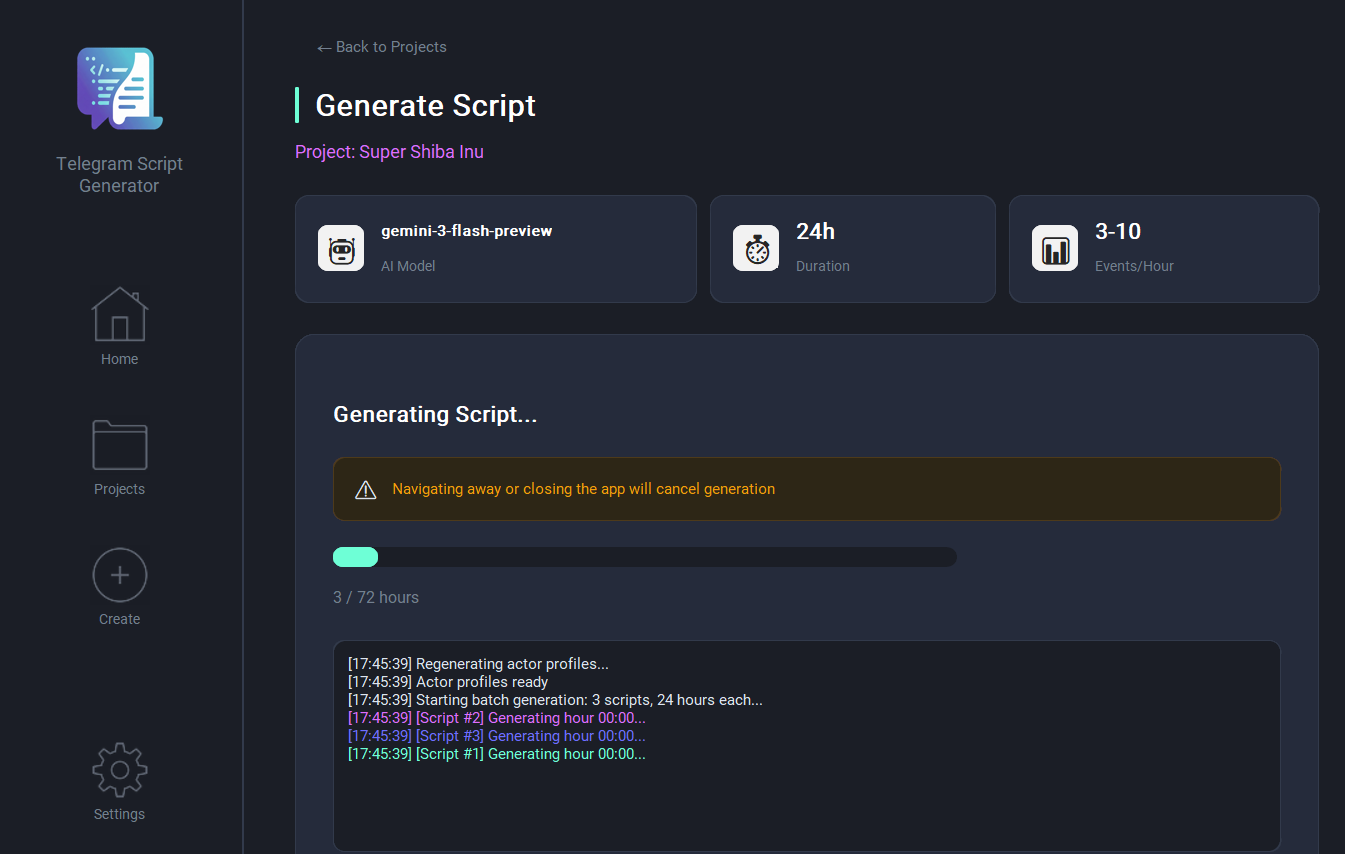
  1. Select your project and click the "Generate Script" button.
  2. Choose how many 24 hour scripts you want to generate in parallel (Max 5).
  3. Monitor the generation progress on your dashboard. Once finished, you can view the scripts directly.
Generating AI scripts
Chatter Bot

Part 2: Chatter Bot

Deploy generated scripts using your session files and proxies.

1

Global Configuration

  1. Open the Chatter Bot application.
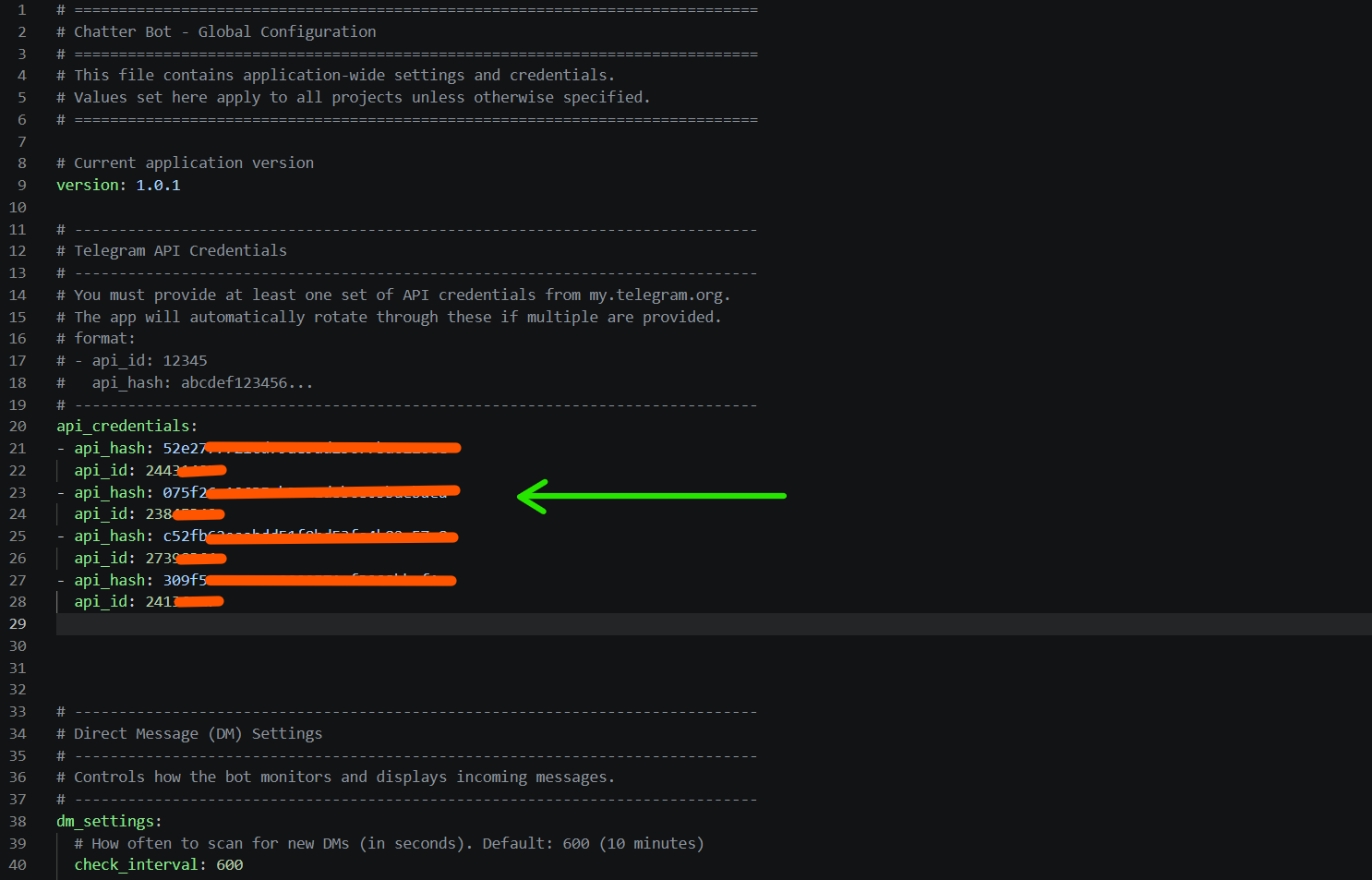
  2. Click the "Settings" button (bottom left) then click "Open" under Global Config, which opens the global_config.yaml file in a text editor.
  3. Under api_credentials, input the api_id and api_hash which you can generate from my.telegram.org. You can add multiple sets to rotate automatically (recommended).
  4. Save the file.
Global Configuration
2

Session Folder Structure

Organize your purchased or generated Telegram .session files into the correct folder structures so the bot can distinguish account roles. Navigate to your workspace and arrange them like so:

  • Mod Accounts: Place session files inside folders prefixed with M_ (e.g., M_447xxxxxxxxx/447xxxxxxxxx.session).
  • Relay Accounts: Place them inside folders prefixed with R_ (e.g., R_447xxxxxxxxx/447xxxxxxxxx.session).
  • Standard Chatter Accounts: Place inside regular folders (e.g., 447xxxxxxxxx/447xxxxxxxxx.session).
Workspace/Sessions
sessions/
 ├── M_447123456789/       # Mod Account
 │    └── 447123456789.session
 ├── R_447987654321/       # Relay Account
 │    └── 447987654321.session
 └── 447555666777/         # Standard Member Account
      └── 447555666777.session
3

Creating Session Files

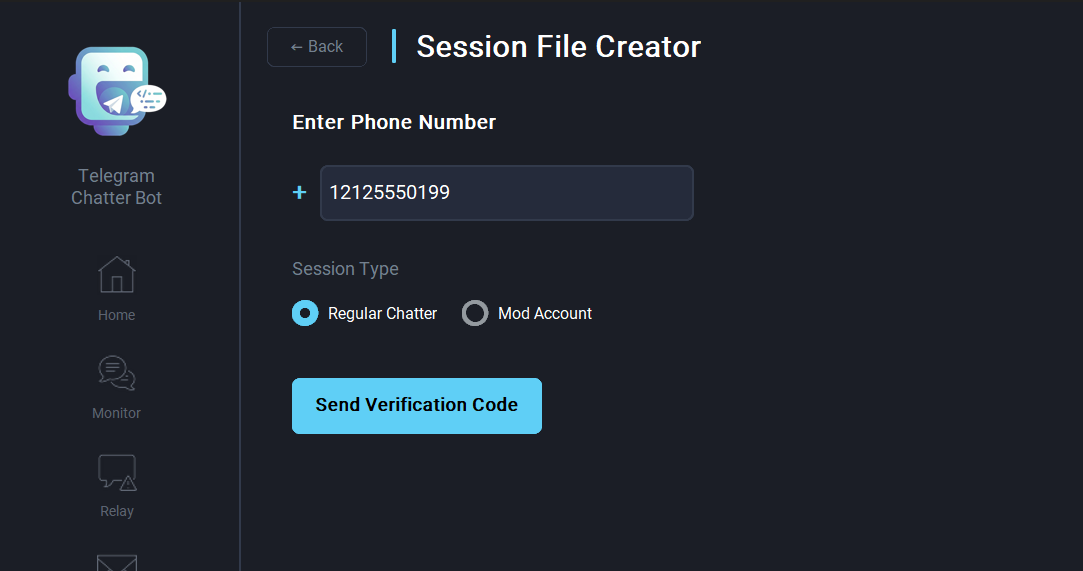
  1. From the main dashboard, click the "Create Session File" button under Quick Actions to launch the account creation tool.
  2. Enter the phone number for the Telegram account and select its intended role: either 'Regular Chatter' or 'Mod Account'.
  3. Click "Send Verification Code", input the code received via Telegram, and finish creating the session file. Repeat this process as needed.
🛡️

Relay Alerts: To receive relay alerts, you must add the R_ prefix to at least one regular session folder (as shown in Step 2). To quickly manage your files, click the "Settings" button and select "Open" under the 'Sessions' category.

Creating Session Files
4

Setting Up the Bot Project

  1. Click "Select Project" under the Dashboard Quick Actions and click "New Project" at the top right of the window.
  2. Project Name: Type the exact same project name you used in the Script Generator for continuity.
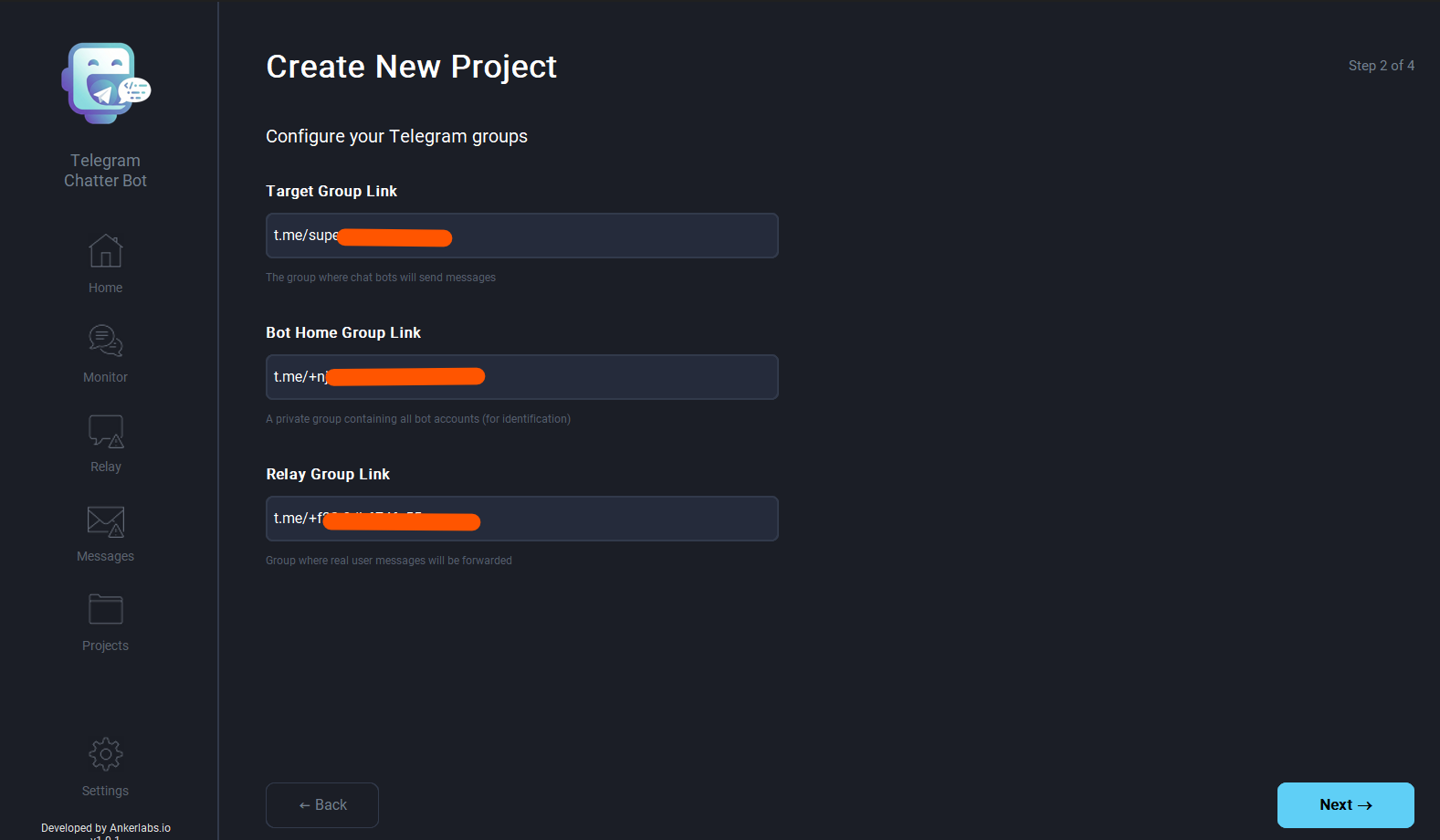
  3. Group Configurations: Provide the links for your required telegram groups:
    • Target Group Link: The main public group where bots will send the scripted messages.
    • Bot Home Group Link: A private, isolated group containing your bot accounts so their identities can be managed and verified.
    • Relay Group Link (Optional): A group where real user messages will be forwarded to you via notifications in the app.
Setting Up the Bot Project
5

Operating and Monitoring the Bot

  1. Once your setup is complete, navigate to your project dashboard within the Chatter Bot.
  2. Copy and paste the scripts generated from the Script Generator into your project's Scripts folder. You can quickly access this by clicking the "Scripts" button on the dashboard.
  3. Open the Live Monitor View and click "Start Bot" to officially run the bot and watch the simulation occur in real time.
  4. The bot will automatically move to the next script once the current one is finished. If the bot is paused or closed, it will resume from where it left off in the last opened script.
👤

Customize Session Files: You can individually customize your accounts by selecting the "Customize Session Files" button under Quick Actions to change roles, names, bios, usernames, and profile images.

📢

Relay Tab

View real-time alerts in the Relay tab on the left navigation bar. These are messages from users outside your network that may require human attention.

📨

Message Center

The Messages tab allows you to respond manually with emojis and scheduled delays. Private messages are filtered to only show senders from your target group.

🤖

Response Logic: Replies to your bots are handled by the specific account targeted. General messages are handled autonomously by one of your Moderator accounts.

⚠️

Persistent Operation: Closing the Chatter Bot will stop bot operations. The application window must remain open for the bot to continue its simulation and allow you to reply to messages.

✍️

Part 3: Custom Prompts

Fine-tuning AI conversation logic and event triggers.

1

Accessing Event Prompts

  1. Open the Script Generator app and click the "Project" button on the left navigation bar.
  2. Click "Edit Prompts" next to your project. This will open the project's prompts folder on your computer.
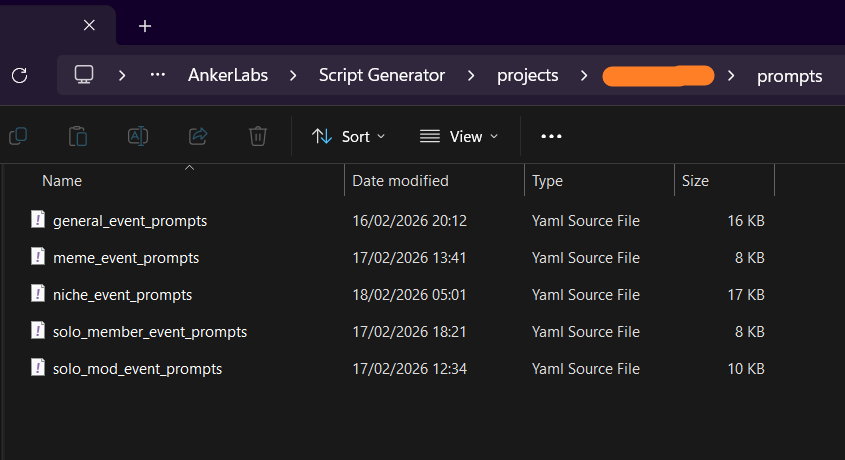
  3. In this folder, you will find several YAML files that control different types of conversation "events."
Project Prompts Folder Structure
2

Understanding Prompt Categories

Each file in the prompts directory targets a specific type of interaction within your Telegram group:

  • General Event Prompts: Universal conversation triggers not specific to your project (e.g., small talk, general crypto sentiment & global events).
  • Niche Event Prompts: Focused strictly on your project details (e.g., tokenomics, roadmap, specific utility).
  • Solo Member Prompts: Events involving a single member that don't trigger replies (e.g., saying "Good Morning" or a greeting).
  • Solo Mod Prompts: Moderator-only messages used for project updates, warnings, or official announcements.
3

Editing & Saving Changes

Open any of the files listed above with a text editor to remove or add your own custom prompts. The AI uses these as core instructions when building your script.

Example: general_event_prompts.yaml
prompts:
  - "member asks if anyone else is worried about WWIII and people share their opinions"
  - "member mentions they just moved into a new neighbourhood and they regret their decision"
  - "member asks how everyone's day is going, people share mixed opinions"
💾

Important: Always save your changes in the text editor. After saving, return to the **Script Generator** and click "Generate Script" again to see your new custom prompts reflected in the generated dialogue.

🖼️

Part 4: Meme Creation

Customizing visual content and meme events for your groups.

1

Accessing Prompt Configurations

  1. Open the Script Generator application and click on the Project navigation button.
  2. Locate your project and click the "Edit Prompts" button. This will automatically open the locally stored prompts folder for your project.
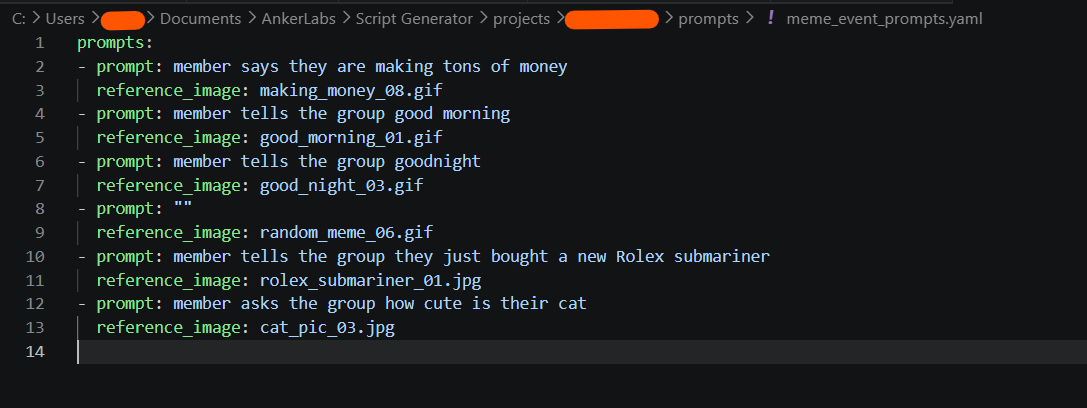
  3. In this folder, find and open the meme_event_prompts.yaml file using any text editor (like Notepad). This file contains the instructions used by the AI to generate visual meme events.
2

Configuring Meme Prompts

To define which images should be posted, you must specify an AI text prompt followed by its corresponding image reference file name. The format must follow the YAML structure shown below:

meme_event_prompts.yaml
prompts:
  - prompt: "member says they are making tons of money"
    reference_image: making_money_08.gif
  - prompt: "member tells the group good morning"
    reference_image: good_morning_01.gif
  - prompt: "" # Leaving prompt empty will post only the image
    reference_image: random_meme_06.gif
Meme Prompt Configuration Layout
3

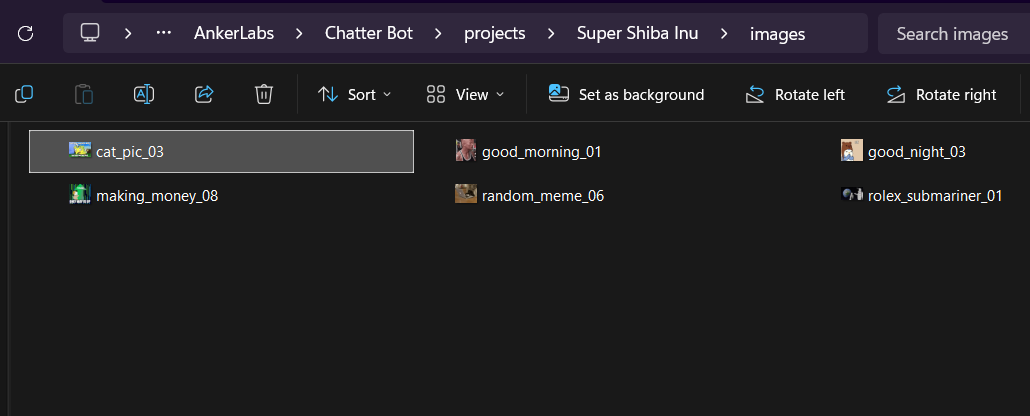
Storage & Image Referencing

  1. All images referenced in your prompt file must be stored in the following directory so the Chatter Bot can retrieve them during execution:
  2. C:\Users\[username]\Documents\AnkerLabs\Chatter Bot\projects\[project_name]\images
  3. Ensure the file names in your meme_event_prompts.yaml exactly match the files stored in the images folder (including extensions like .jpg or .gif).
Correct Image Storage for Meme Events
💡

Workflow Tip: When the Chatter Bot runs your generated script, it will automatically look up the image references and post the corresponding visual content whenever a meme event is triggered.